
Beijing Model and Its False Propaganda to Control Air Pollution
This is how differences are shown by Chinese propaganda to the world, today.

But, this was the reality of China. Haze were visible from space.

Global Model Examples of Air Pollution Control
- Beijing, China - Earlier AQI: Hazardous | Current AQI: Poor - Unhealthy
- London, United Kingdom - Earlier AQI: Hazardous | Current AQI: Good
- Los Angeles, USA - Earlier AQI: Severe | Current AQI: Moderate
- Tokyo, Japan - Earlier AQI: Severe | Current AQI: Good
- Seoul, South Korea - Earlier AQI: Severe | Current AQI: Moderate
As China claims that it is in better condition now but we never got to know how and at what cost it is better today.
What about Delhi?
It is completely understandable that the countries I've mentioned above were most polluted during their developing phase. Now, they are considered as the most developed megacities of the world. But India is still developing, resulting in severe air pollution.
Now, India needs to create a new model to mitigate its air pollution not imitating other models such as Beijing model. Because...
“Solutions must emerge from the soil in which problems exist.”
Meanwhile, it is essential to keep it in our mind that: Air pollution is reversible and Economic growth ≠ dirty air.
How Beijing (China) controlled its air pollution along with development?
“Air pollution is a leading cause of premature death worldwide. — World Health Organization (WHO)”
Understanding Beijing's air pollution story is crucial for any nation, district or municipality that wishes to follow a similar path.
As the capital of China and an international metropolis, Beijing has experienced rapid development in the past two decades. Compared with 20 years earlier, the GDP, population and vehicles of Beijing sharply increased by 1078%, 74% and 335% respectively at the end of 2017.
The great economic prosperity and urban growth have also resulted in the deterioration of the city's environment, especially air quality. The characteristics of combined coal-vehicle pollution are unceasingly apparent and heavy pollution episodes occurred regularly, with negative effects on public health.
From Airpocalypse to Olympic Blue
Airpocalypse
Airpocalypse refers to an episode of severe, hazardous air pollution where smog becomes so dense that normal life is disrupted. A public-health disaster caused by unchecked air pollution. It was coined by foreign media and residents in Beijing around 2012–2013. Used to describe days when PM2.5 levels crossed 500–900 µg/m³ (WHO safe limit: 5 µg/m³ annual average).
Olympic Blue
The term originated in China, specifically during the 2008 Beijing Summer Olympics. During the 2008 Olympics, Beijing witnessed unusually clear blue skies due to strict, extraordinary measures such as shutting down polluting industries, restricting vehicles, and halting construction. However, before the Olympics, these blue skies appeared only intermittently during trial restrictions, revealing how fragile and artificial the improvement was.
However, the term is slightly ironic because: It implies that the blue sky was not natural or permanent, it appeared because of temporary, very strict pollution-control measures, and once the event ended, pollution often returned.
After the Games ended, many emergency controls were relaxed, and air pollution gradually returned, turning "Olympic Blue" into a metaphor for short-lived environmental success driven by global scrutiny rather than sustained policy commitment. This showed the improvement was artificial.

The Scale of China's Air Pollution Problem
According to the 2021 World Air Quality Report, out of 1,374 cities located in East Asia, 143 (or about 11%) recorded annual average PM2.5 concentrations that are seven times greater than World Health Organization (WHO) standards. All of them were located in China, with the town of Hotan in southwestern Xinjiang experiencing the highest level of pollution in the country at about 101 µg/m³, over 20 times the WHO guideline value.
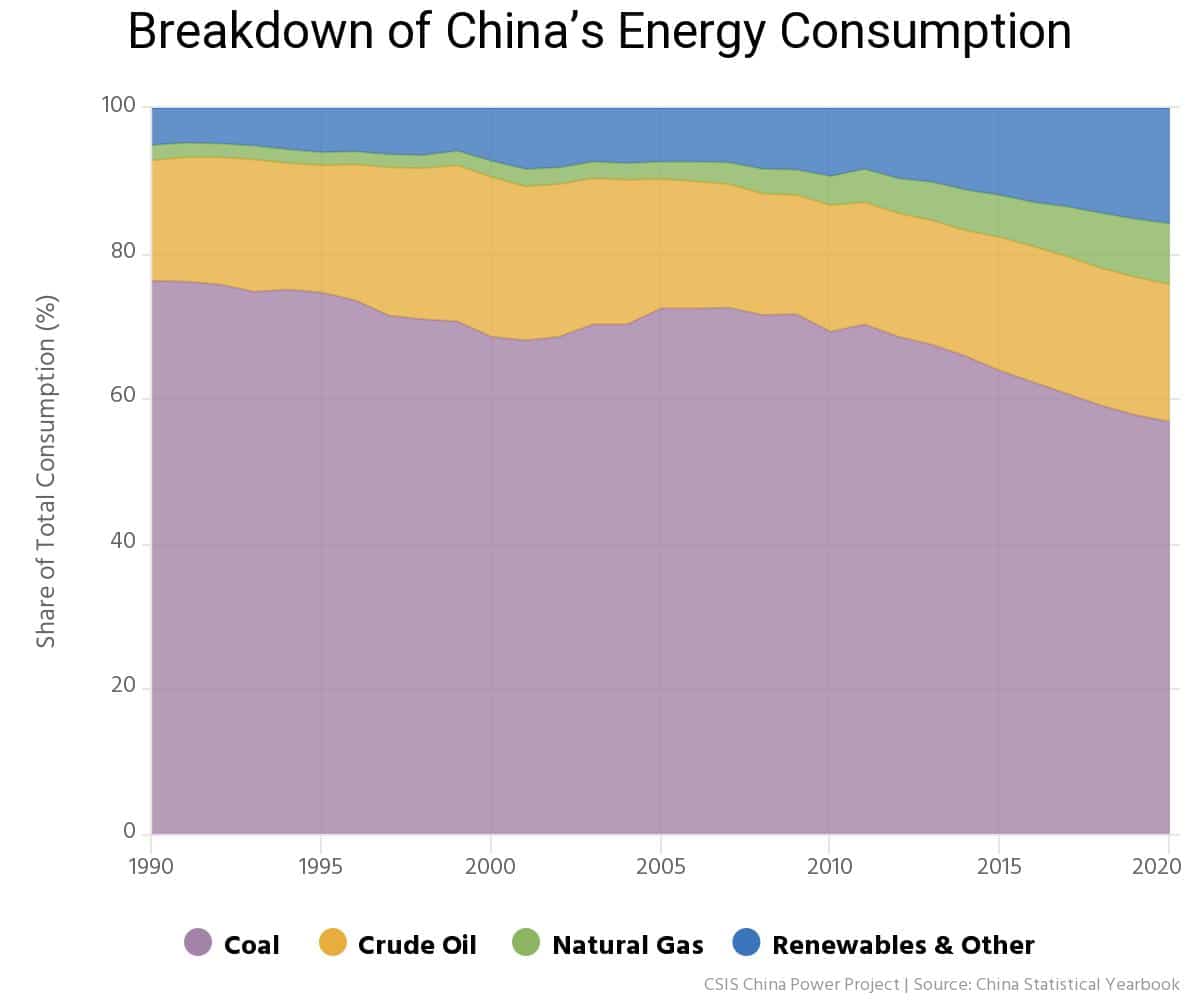
Estimated to cause an average of 1.2 million premature deaths every year, China's poor air quality is primarily attributed to the rapid economic expansion the country experienced since 1979, which resulted in a drastic increase in coal-powered industrial production and electricity demand, as well as an exponential rise in private vehicles. It is estimated that roughly 48% of Chinese CO2 emissions come from the industrial sector, with 40% from the power – mainly coal – and 8% from the transport industry.
Furthermore, despite pledging to reach net zero emissions before 2060, the country remains by far the world's largest producer and consumer of coal, which alone covers 60% of its electricity demand. In an effort to restore the economy to pre-pandemic levels and curb the energy crisis sparked by the exponential rise in industrial activities the country experienced in 2021, the Chinese government ordered factories to increase their production capacity and built more than triple the amount of new coal power capacity as the rest of the world combined. Unsurprisingly, CO2 emissions in the same year almost reached 12 billion tonnes, accounting for 33% of the global total.
Similar to other large cities in industrialised countries like Los Angeles, London and Tokyo; Beijing experienced the rapid emergence of air pollution. In response, in 1998, the Beijing Municipal Government published the Announcement of Urgent Measures to Control Air Pollution of People's Government of Beijing Municipality, which was the first local government declaration in China on air pollution control. This document announced "Beijing's war against air pollution." But nothing happened in reality, these policies remained on paper only.
In 2013 The AQI reached to 800+ (very similar to the situation of Delhi in December 2025), one of the most severe air pollution events in its history. The situation was getting worse but sadly citizens of China can't raise questions on air pollution.
Do you know why? Because of Tiananmen Square Massacre in 1989.

Student-led protests, known in China as the June Fourth Incident, were held in Tiananmen Square in Beijing, China, from 15 April to 4 June 1989. After weeks of unsuccessful attempts between the demonstrators and the Chinese government to find a peaceful resolution, the Chinese government deployed troops to occupy the square on the night of 3 June in what is referred to as the Tiananmen Square massacre.
The night of June 3 and 4, the People's Liberation Army stormed the Square with tanks, crushing the protests with terrible human costs. Estimates of the numbers killed vary. The Chinese Government has asserted that injuries exceeded 3,000 and that over 200 individuals, including 36 university students, were killed that night. Western sources, however, are skeptical of the official Chinese report and most frequently cite the toll as hundreds or even thousands killed.
Since then, nobody dared to protest in China, because they have already seen the consequences they have to face after protests.
Beijing became the first city in the world where people started wearing masks without any disease and carrying oxygen cylinders with them wherever they go. Children used to carry oxygen cylinders with them during school hours. It became the first City where schools were shut down due to pollution. It became the first city in the world where people have to install air purifiers in their homes and the first city where lockdown happened. People were suffering silently because they had no choice left.
In 2013, Chen Jiping, former leading member of the party's Committee of Political and Legislative Affairs said that environmental issues are a major reason for "mass incidents" in China—unofficial gatherings of one hundred or more that range from peaceful protest to rioting.
But the climax began when the USA and Europe entered into this matter. Through NASA, ESA, and the media, they spilled the tea over the world that China is facing hazardous air pollution and displayed this through live AQI. Now, Air pollution mitigation has become a crucial political challenge for the country's political leadership.
China is the world's largest source of carbon emissions, and the air quality of many of its major cities fails to meet international health standards. (Due to air pollution, life expectancy in China is 75.3 years, according to 2013 UN figures).
China's Three-Stage Action Plans
STAGE 1: Air Pollution Prevention and Control Action Plan (2013–2017)
The first major nationwide strategy that introduced structural controls, accountability and measurable targets for reducing pollutants such as PM2.5. This was issued by state council of China, an action plan on prevention and control of air pollution.
STAGE 2: Three-Year Action Plan to Win the War to Defend Blue Skies (2018–2020)
Strengthened earlier measures with more detailed emissions targets and deadlines (e.g., reducing PM2.5 and major pollutant emissions). 'China Daily' issued three year action plan to control air pollution.
STAGE 3: Action Plan for Continuous Improvement of Air Quality (2023–2025)
The latest plan sets new goals by 2025, including:
- Reducing average PM2.5 concentrations by 10% in cities above prefecture level relative to 2020
- Limiting the share of severe air pollution days to ≤1% per year
- Cutting total emissions of nitrogen oxides and volatile organic compounds (VOCs) by over 10%
- Setting stricter regional targets (e.g., larger cuts in Beijing-Tianjin-Hebei and Fenwei Plain)
- Promoting green transformation across industries, energy, and transport
How Bad Was It?
- China is the world's largest emitter of greenhouse gases, having overtaken the United States in 2007, and was responsible for 27 percent of global emissions in 2014
- The country's energy consumption has ballooned, with reports from late 2015 implying that it consumed up to 17 percent more coal than previously reported
- In January 2013, Beijing experienced a prolonged bout of smog so severe that citizens dubbed it an "airpocalypse"; the concentration of hazardous particles was forty times the level deemed safe by the WHO
Development of Beijing's Air Quality Management System
1. Air Pollution Control Plans
China's environmental protest movement (especially due to the shift from rural based protest to urban protest) has worried the top leadership, which views the unrest as a threat to the party's legitimacy. "Air pollution in China has turned into a major social problem and its mitigation has become a crucial political challenge for the country's political leadership," write Center for Strategic and International Studies's Jane Nakano and Hong Yang. President Xi Jinping pledged at the National People's Congress to punish violators of environmental laws with an "iron hand".
Yet the government has responded to public outcries: Chinese Premier Li Keqiang declared a "war on pollution" in March 2014; in May of the same year the government strengthened the country's Environmental Protection Law for the first time in twenty-five years.
However, it is premature to celebrate the end of China's war against pollution. The PM2.5 concentration of 29 μg/m³ still falls short of the WHO standard of 5 μg/m³. More concerning is that after a decade of decline since 2013, the overall PM2.5 levels in China rebounded for the first time in 2023. This increase in PM2.5 levels occurred in 80 percent of China's provincial capitals, including Beijing.
Meanwhile, there is no indication that the government is reversing the increasing trend of other pollutants, such as ozone (O₃). In the absence of a multi-pollutant emission reduction strategy that coordinates the control of both PM2.5 and O₃ pollution, the density of O3 tends to rise as PM2.5 concentrations fall. Prior to the pandemic, there had been a significant increase in O3 concentration in China, contributing to 90.1 percent of the rise in ozone-related mortality from 2013 to 2019. The problem has persisted, with the average ozone concentration in monitored cities reaching 145 μg/m³ in 2022, up by 5.8 percent from 2021.
“The proof will be on the ground—and of course, in the atmosphere.”
2. Local Regulations and Emission Standards
There were a record 17 million new cars on the road in 2014, further contributing to China's high emissions. Car ownership was up to 154 million, according to China's Ministry of Public Security, compared to roughly 27 million in 2004. Another trend compounding air problems has been the country's staggering pace of urbanization, a national priority. The government aims to have more than 60 percent of the Chinese population living in cities by 2020.
There were Forced Industrial Shutdowns Without Compensation; thousands of small and medium factories (steel, cement, brick kilns, chemicals) were shut down overnight, sealed by local officials, in fact, sometimes demolished factories and small industries to prevent reopening. Workers often lost jobs without prior notice or social security cover. These closures were rarely highlighted in official success stories.
And you know why it worked? Because Industrial PM2.5 emissions dropped sharply, especially around Beijing–Tianjin–Hebei, and that was also a forcible action. This is how China prevented industrial emissions.
The government of China implemented traffic Restrictions that ignored public convenience. China launched sudden Odd-even schemes, Diesel bans, Entry bans for older vehicles. Vehicles were confiscated or scrapped with limited appeals. China completely ignored the Public convenience, it was just its determination to show the world that how fast China can solve its problems. Public transport expansion came after, not before, restrictions.
3. Law Enforcement
In Beijing, there are two levels of environmental law enforcement - municipal level and district level, with each level having differing responsibilities for cooperation in relation to the other. Because China is an authoritarian state, surrounding regions are supposed to co-operate.
In 2017, an environmental police team was created under the Beijing Municipal Bureau of Public Security. Through joint law enforcement, environmental protection departments can transfer cases of suspected environmental crimes to public security departments according to law, which has greatly enhanced the deterrent power of environmental law enforcement.
Moreover, there were collective punishment of local officials. Air quality targets were linked directly to promotions and careers of local officials. If pollution spiked, district magistrates, Mayors, Party secretaries were demoted, fined, or removed. Some officials enforced extreme measures out of fear, such as: Blanket bans on construction, Mass factory closures regardless of economic cost. This pressure is rarely discussed openly, but it drove ruthless enforcement.
4. Economic Policies
In terms of industrial pollution prevention and control, incentives or subsidies were granted for high-polluting enterprises that choose to close their production or to implement extensive exhaust gas treatment. For those who chose to remain in production, differentiated fees are charged according to the concentration of waste gas emissions.
The funding stood at 1.7 billion Yuan in 2009, and climbed to 18.22 billion Yuan in 2017, an increase of nearly ten times in eight years.
5. Enhancement of Monitoring Capacity
Some local governments had forced monitoring stations to tamper with air quality figures, according to a report in state-owned news agency Xinhua, which quoted Wu Xiaoqing, vice minister of environmental protection.
“The average daily reading of PM 2.5 levels in Beijing in 2014 was 98.57, 15% higher than the government statistics that claim 85.9.”
The research added that air quality in the capital was twice as severe than the government has admitted, and that Beijing has had five polluted days out of every seven for the last two years. Beijing's 35 air quality monitoring stations throughout the city are often located far away from each other, providing a wide variety of results. But the final air pollution figure is the average of all monitoring sites combined, no matter the variance between them. That means that if the air is better in rural areas, it will drag down the PM 2.5 reading when balanced with higher pollution levels in the most built-up areas.
6. Information Release and Public Participation
China's government probed rigged air pollution data, while research says manipulation of monitoring stations means air quality in Beijing is much worse than acknowledged. The released information which the government of China did to show the world was fake and manipulated.
7. Environmental Awareness and Public Participation
Different activities and campaigns to enhance public participation in environmental protection were developed for specific target groups. The internet has played a crucial role in allowing citizens to spread information about the environment, placing additional political pressure on the government. So the government blocked the release of information outside China. In fact, the government silenced the environmental dissent.
Environmental NGOs and citizen groups were allowed only if aligned with government goals, and NGOs were restricted if they questioned data or policy harm. Independent air-quality activism was discouraged to control the narrative.
8. Intrusive Surveillance of Citizens' Daily Life
With the use of CCTV, Drones, neighbourhood committees to monitor, the officials of China kept intrusive surveillance on citizen's daily life such as garbage burning, coal stove usage, illegal diesel generators, residents were publicly named or fined for violations in some localities. These measures are high intrusion into privacy, especially in poorer areas.
9. Forced Conversion of Household Heating
Millions of households were ordered to stop using coal stoves, and to switch to gas or electric heating. They were forced to do so, government didn't even think a moment that how people who are below poverty are going to switch to gas or electric heating. In several regions, gas supply was inadequate and in result people had to endure freezing winters. Complaints were often suppressed to maintain policy targets. This episode is underreported in official narratives, though acknowledged in academic studies.

Summary of China's Plan of Action
- China publishes outcomes, not social costs
- Local enforcement details remain administratively opaque
- English-language reports focus on policy design, not coercion
- Media discussion of public suffering is politically sensitive
China's air-pollution success was not only technological or policy-driven. It was achieved through: Authoritarian enforcement, Top-down coercion, Sacrifice of individual convenience, jobs, and choice.
But no! Indians wants to follow Beijing model or Washington model or any model wholesale, instead of using their own knowledge and technology. India is capable enough to solve her problem in her own way, India don't lack technology. It is just Chinese propaganda which manipulated most of the Indians. As I've mentioned above the solutions must emerge from the soil in which problem exists.
What India Must NOT Copy from China
1. Beijing operates under an authoritarian system. Policies are enforced swiftly, strictly and uniformly. Delhi functions within a democratic framework where multiple governments, courts and public consent shape outcomes. What works there cannot be imposed here the same way.
2. Beijing spent billions of dollars cleaning its air. It shut or relocated thousands of industries and enforced ultra strict emission standards. India cannot afford that scale of spending or disruption under current fiscal constraints.
3. Delhi's pollution sources are more complex: Crop residue burning across states, Biomass use for cooking and heating, Millions of informal small enterprises, Unregulated construction and transport. These challenges never existed at Beijing's scale.
Chinese Practice vs Why India Must Avoid
- Forced factory demolitions → Violates rule of law
- Collective punishment of citizens → Unconstitutional
- Surveillance-driven enforcement → Violates privacy
- Silencing environmental criticism → Against free speech
- Sudden fuel bans without alternatives → Social injustice
Conclusion
China demonstrates that air pollution can be reduced quickly. India must demonstrate something harder and more valuable: that clean air can be achieved within the framework of democracy, legality, and social justice. The choice before India is not between development and environment, or between speed and rights, but between short-term optics and long-term institutional reform. Clean air secured by strong institutions will last longer than blue skies produced by temporary coercion.
Beijing didn't succeed but Beijing's propaganda did, because of strict and continuous enforcement and social injustice. Delhi's challenge is not lack of solutions, but weak implementation and fragmented governance.
Sources
- https://dialogue.earth/en/pollution/7828-china-promises-crackdown-on-fake-air-quality-data/
- https://en.wikipedia.org/wiki/1989_Tiananmen_Square_protests_and_massacre
- https://www.cfr.org/blog/chinas-battle-against-air-pollution-update
- https://wedocs.unep.org/items/3e70d8e5-a90a-4b64-a7d2-bf49fcd6222a